The Creative City. It’s War.

0041-1THE USE OF ‘WAR’ TO DESCRIBE CITY LIFE IS A CULTURAL STUDIES CLICHE. In City of Quartz (1990) Mike Davis famously described Los Angeles as ‘militarized’, thinking of the bum-proof benches of downtown, and signs on suburban lawns warning of ‘armed response’ to intrusion. Teresa Caldeira’s account of São Paulo, City of Walls (2001) did something similar for the Brazilian metropolis, describing a city so conditioned by fear of crime that it might as well be at war. I’ve used the metaphor of warfare plenty of times myself, for example in my own accounts of Brazilian cities, which noted the tendency of local journalists to describe them as being in a state of de facto civil war. In that piece, I referred to a much-quoted statistic: during the four-year siege of Sarajevo 1992-6, more people of were killed on the streets of Rio de Janeiro, ostensibly a city at peace. War is a cliche, however, and an increasingly inaccurate one in these terms. LA, New York, São Paulo, Rio (etc. etc.) have become immeasurably safer since everyone started talking about how dangerous they were. And while Baghdad kills 50 or so people per day in a state of genuine warfare, it is frankly unethical to even use the term in relation to what are safe and wealthy places.

Still, that is what I am going to do. In my last post, I mentioned Richard E. Caves’s Creative Industries (2000) in relation to the sociability, or otherwise, of the creative city. The  intense, but intermittent, sociability of the creative city is in fact that of a condition of emergency. As Rebecca Solnit has written lately (A Paradise Built in Hell, 2009) natural disasters destroy communities, but also  produce  marvellous new ones. The more I thought about them, the more Caves’s core principles suggested such a condition of emergency. ‘Nobody Knows’, the ‘Motley Crew’, ‘Time Flies’ (and the rest) invoke an exceptional state of being. The future is unknown and unknowable, threats are permanent, change is ever-present, the project (movie, exhibition, artwork, performance, book, campaign) routinely demands the impossible. Time is  essential; everything must be now. The resources required are immense: it must store materials, skills and ideas in anticipation of a future that may never occur. It is subject to high levels of security and secrecy. Its workers are mobile and rootless, and live in de facto camps, separated and sometimes secured from the city proper. And each project – for which read ‘campaign’ – demands absolute commitment. Desertion is death.

Caves doesn’t describe the creative city in quite these terms, but the implication is there to  be had. And at the time he was writing, there were plenty of other writers invoking a sense of emergency in contemporary life: the sociologist Ulrich Beck’s ‘risk society’ is a perfect example.

On the ground, there are real figures of this metaphorical war. Superficially, many of the most creative cities have also been literal ruins at some stage of their development, caused, often enough by conflict (Berlin, London and Manchester bore until recently the literal scars of war). Artists have always been drawn to the ruined parts of cities for economic reasons, but they have also long cultivated an aesthetic of ruination – and resisted attempts to clean up. The creative city and the ruined city often seem to overlap.

However there’s more to this metaphorical war than ruins. Caves says a lot about LA and the movie industry, and if you know that city, you know how reminiscent its great studio complexes are of military encampments or munitions factories: sprawling, secure complexes, surrounded by high walls, blind to the outside world. And inside, they’re populated by transient gangs working secretly to impossible deadlines, for campaigns that become apparent only when they’re in progress. Making movies is uncannily like going to war. It’s no accident that war has been such a natural movie genre. And it’s arguably no accident that LA’s other main activity, at least until the 1980s, was armaments.

If the creative city is also metaphorically a city at war, is it right? The creative city undoubtedly suits those with the wits and education to take advantage of it, and weather its vicissitudes. I have thought of myself in that category often enough. But how does the creative city suit the weak, the sick, the very young? How does it work for anyone thinking beyond the next pitch?

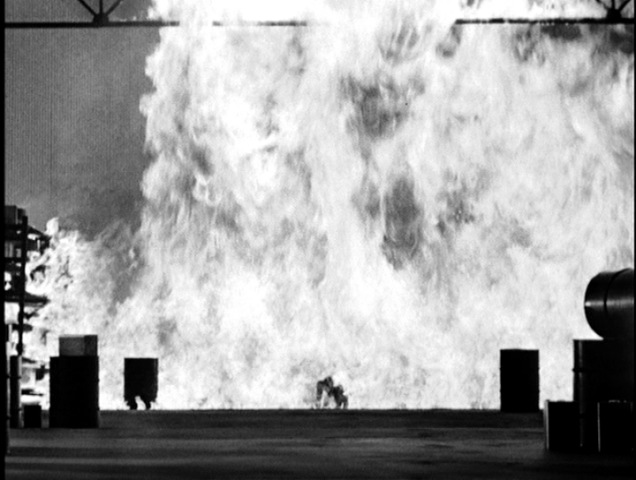
Picture: Still from Alfred Hitchcock, ‘Saboteur’ (1942). Exploding munitions factory created on a Warner Bros studio lot.

THE CREATIVE CITY: A CORRECTION

Image
Since posting, Paul Morley published this piece on the Salford and Media City, which is connected. Most accounts of Media City have been unfavourable – sometimes simple snobbery, sometimes a failure to understand the landscape and its history.This discussion is more nuanced, and well worth reading. http://www.ft.com/cms/s/2/f5cc1646-c90b-11e2-9d2a-00144feab7de.html#axzz2VEXeJU4s

We hear a lot about the creative city these days. For city managers in the industrialised world, creativity is the way to go, meaning a rebalancing of urban economies away from manufacturing, and even financial services, towards advertising, the arts, culture, web design and so on. The chief advocate of the creative city is Richard Florida, a most entrepreneurially-minded sociologist. Florida is everywhere, and his concepts have been accepted by city leaders the world over. Good for him. His work, however, is predictive and future-oriented; there remains a notable deficit in the literature of the creative city as built, the ‘real’ creative city.

One writer to take it seriously is Richard E. Caves, a Harvard law professor with longstanding interests in copyright. His book The Creative Industries – although published a decade ago – is a compelling, and still rare, analysis of the creative city as it exists and functions, rather than as a fantasy yet to be built. Caves’s argument revolves around a set of principles, which he says, describe unique behaviours of those working in the creative industries. These include (1) ‘nobody knows’ – no-one has the least idea of the likely success of a creative product, with no predictable connection between the capital investment in a project and its likely profitability; (2) the ‘motley crew’ – the necessity for an extremely diverse set of skills to realise projects, most likely supplied by a flexible, self-employed labour force; (3) ‘time flies’, the principle that once underway, a creative project will require absolute subservience to its timetable; (4) ‘art for arts’ sake’, in other words the principle that the actors in creative enterprises are not motivated solely by financial gain, and in many cases will work for the sake of the work itself. The sociologist Sharon Zukin described something similar, the AMP or Artistic Mode of Production, in her celebrated book Loft Living. Caves’s book is underwritten by the detailed knowledge of two cities, LA, focused on the experience of the movie industry, and New York, with a concentration on the art scene, at (I would note) a moment of great transition.

Caves’s principles, if we accept them, have severe implications for the nature of the creative city, indeed the city in general. It is widely assumed that the creative city is intensely sociable. The theme of sociability runs all the way through Florida’s work, for example. Creative types are by their nature gregarious, we are led to believe, and visibly so. They spend all day in cafes, yacking away to each other, tweeting their friends, making deals. That image is widely, and popularly understood; it drives real estate markets, provides fodder for TV, informs fashions in food and clothing and gadgets. It’s immensely popular with city politicians and managers too, for obvious reasons.

But it’s misleading. Caves’s principles imply a city that is far more anti-social than you might expect. Firstly, the creative industries are hopelessly profligate (‘nobody knows’), so they have en enormous amount invested in storage of all kinds. Materials, talent, ideas – most of which, most of the time remain unused, but must be kept available. Storage means space rather than sociability. Secondly, creative workers by and large are not working together, but as individuals who come together on a project-by-project basis (the ‘motley crew’). They’re subject to fits of intense socialisation to get business, but their work, most of the time, is not sociable. Thirdly, ‘time flies’: the creative city sublimates everything to the ‘now’ of the project, cutting across the normal time and space of city. It makes people subservient to the project, not the community. And so on. In summary, if you buy Caves, you buy into a world view that is arguably as anti-urban as it is urban. I don’t present this as a criticism at all, merely an observation. We have choices, after all.

Here is an example of why I think Caves’s analysis is right, namely the large, impressive media complex in Salford, Manchester, MediaCityUK, opened in 2012 and home for a substantial portion of BBC activity. You arrive at MCUK by newly-built light rail at a public plaza defined by glass buildings. There are outdoor TV screens everywhere; coffee and food abound; there are constant ‘events’ of one kind or another. It’s a relentlessly sociable place, almost exactly as the developers imagined. They must be delighted, and rightly so. Walk a few hundred metres to the north, however, and the sense of civilised urbanity falls away, and you find yourself in a warehouse zone, all blank walls and razor wire, seemingly uninhibited. Before MCUK, it was perhaps the definitive landscape of this part of Manchester. Many of the journalistic accounts of MCUK have focused on this disjunction, as if it were a fault. Yet on closer analysis, MCUK merely describes in built form the nature of the creative city. It’s sociable, but only intermittently so. The vast majority of its revenue-producing business comes from things beyond public view. Those warehouses look abandoned, but they house production facilities, sound stages, sets and props, as well as a huge range of informal workspaces. MCUK’s plaza is the public performance, as it were, of the creative city. The real work happens elsewhere.

MCUK was a purpose-built facility, a set piece. In form it reiterates the landscape of arguably the world’s first creative city. It’s an industrial-looking sprawl, dotted with pockets of frantic socialisation. The movie industry, which defines so much of the city, made it like that. The studios are epic in scale, but necessarily inward-looking and anti-social; their public faces, like the attractions on Hollywood Blvd., are designed, quite purposely, to direct attention away from their real business. So it is with all the other motors of the creative city. Far from being drivers of sociability, these businesses are, for most of the people involved in them, most of the time, deeply anti-social. That’s not, as I say, a criticism. But it’s worth pointing out that if sociable cities are a priority, then ‘creativity’ may not be the way to achieve it.

Richard E. Caves, The Creative Industries: Contracts Between Art and Commerce (Cambridge, Mass.:Harvard UP, 2002)

Richard Florida, The Rise of the Creative Class (New York: Basic Books, 2004)

Sharon Zukin, Loft Living (New Brunswick: Rutgers UP, 1989)

Interview with Sharon Zukin

First posted 24 July 2012 on http://citythreepointzero.wordpress.com

NAKED CITY: ON AUTHENTICITY AND URBAN CITIZENSHIP. AN INTERVIEW WITH SHARON ZUKIN

Naked City

Sharon Zukin is Professor of Sociology at CUNY Brooklyn College, New York. One of the United States’s most widely read sociologists, she has been an active participant for many years in public debates on cities.  Regeneration, and the place of culture in cities are particular interests. Her latest book is Naked City (OUP, 2010). She is interviewed here by Richard J. Williams, Professor of Contemporary Visual Cultures at the University of Edinburgh. The interview took place in a quiet alcove in in the University’s Playfair library on 11 June 2012.

R.W: To start with, if you could say something about your last book, The Naked City, which was very widely read. Looking back on that, what was that about, what was the main thing you wanted to say? 

S.Z: Just as the novelist, Paul Auster, has a New York trilogy, I think I as an urbanist have a New York trilogy. Naked City is the third instalment after Loft Living and the Cultures of Cities – the last instalment in my attempt to look back over thirty years of change in New York, from about 1980 to 2010, and to come to grips with the economic, social and cultural sources of change.  Some people say that New York City has lost its soul during the past thirty years, and to a certain degree I agree with that. There have been changes that have made New York more like other cities. Also, they have made New York a more expensive city and a less fascinating place. I was concerned to look back over the same area that I had researched for thirty years to try to understand better, and more deeply, the causes of these changes.

R.W: There is a word that you use in Naked City – and I think it is in the subtitle – ‘authenticity’.

S.Z: Yes, the A word.

R.W: The A word. That’s a word that gets used in lots of different contexts.  What do you mean by ‘authenticity’ in this urban context?

S.Z: I chose very deliberately to use the word ‘authenticity’ to talk about changes in New York.  I wanted the slipperyness of the term to allow people to understand that the city changes in ways that are both acceptable and not acceptable for both objective and subjective reasons, and our criteria for evaluating change in the city are both objective and subjective.  I wanted to come to grips with the constant changes in big cities which we experience as making them “inauthentic” and the necessity of adapting to the new people who come to the city all the time. New York, for example, is a city that regularly acknowledges its immigrant bases. Even the mayors talk about New York as an immigrant city. They are not ashamed of that.  And I wanted, simultaneously, to defend longtime residents’ right to stay in place against forces of eviction and newcomers’ right to establish their own places in the city.  So I chose a term, ‘authenticity’, that would include both origins in a very primeval sense, and new beginnings in the sense of constant change.

R.W: There are lots of examples of what you call ‘authentic’ spaces in the book. If you were to pick one of those, what would it be?

S.Z: It’s hard to say now. I used to answer by saying that ‘my neighbourhood’, which is Greenwich Village, is an authentic space, but Greenwich Village is very much beleaguered.  There are zoning rules and historic district designations that prevent wholesale demolitions and rebuilding in a monolithic skyscraper format. But the area has become much more expensive in recent years. There has been a huge influx of students at New York University, which is a very large, private university in this district. And during the past couple of years I have seen my neighbourhood shopping street, my little local high street, change into a service centre and restaurant mall for undergraduates.

R.W: Yes, a mall is, I think, a great word to describe what’s happened there.

S.Z: Very much so.  This transformation has occurred at the same time that the nearest public park, Union Square Park, has become a tremendously lively public space, much better used and more deeply used by the public than ever before.

R.W: Yes.

S.Z: Even though – and I write about this in the book – the public space of Union Square is managed by a private business association (which is called, because it carries out public functions of managing public space, a public-private partnership).  So I don’t know what authentic spaces are left in New York City. I’m hoping that the city as a whole still appears authentic.

R.W: Well, I think it certainly does.  My favourite authentic space you describe was the Hispanic food courts – food carts, I mean …

S.Z: Trucks.

R.W: Food trucks – and this is not actually in Manhattan, it’s in Brooklyn.  Is that culture still going on?

S.Z: Yes it is.  And it’s really a story of how foodies shaped views of the space’s authenticity. The acceptance of the Latino food vendors, who come from a number of different Central American and South American countries by the broader public was conditioned by food blogs that began to appear on the Internet in the early 2000s. The Latinos had been selling food at the soccer fields in Red Hook, near the Brooklyn waterfront, since the 1970’s, at first very informally and then more formally as a cash & carry operation.  By the late 1990s or early 2000s, a lot of foodies from different ethnic and social backgrounds had become acquainted with the Salvadoran papusas and Mexican huaraches and all sorts of other dishes, and they began to talk and write about these foods.  So their tastes for exotic foods, or should I say for the authentic foods of the homelands of immigrants, drew a lot of other people, not immigrants and not Latinos, to Red Hook.  Meanwhile, Red Hook, which had been quite a dilapidated industrial port area and a working-class neighbourhood since the 1960s gradually began to pick up.  I can’t say Red Hook has been gentrified, but a small number of good restaurants owned by young chefs and bars and food shops opened there, and then finally, in 2009, a giant branch of Ikea, the Swedish modern furniture chain, opened on the waterfront.  So, you could almost see the neighbourhood of Red Hook caught in the vise of dependence on two types of globalisation: globalisation in a big way by Ikea, and globalisation in a small way by the Latino food vendors.

R.W: Mm.  I was just fascinated by this collision of two different kinds of globalisation – an unstable but fascinating situation – full of contradictions.

S.Z: Yes, it is really fascinating.  It’s probably the districts that are teetering on the jagged edges of underdevelopment and commercial globalisation that we find most interesting now. Probably that was also true of New York in the 1970s, when so many creative people moved to downtown locations and really thrived on these jagged edges – moving between security and danger.

R.W: Mm.  There’s a figure, a great figure, who runs all the way through the book, and that’s Jane Jacobs, the urbanist.  What does Jacobs, and her book ‘The Death and Life of Great American Cities’, mean to you exactly?

S.Z: Jacobs is the iconic thinker and observer of cities, particularly US cities. She is the person who, against all odds in the mid twentieth century, extolled the messiness, the grittiness, the tentativeness, but also the firm friendships of city life.  When I say against all odds, I mean against the extreme pressure of suburbanisation in terms of investment of funds, building of infrastructure and movement of the middle class from the cities.  Suburbanisation was the strongest force changing the habitat of Americans in the last half of the twentieth century.  And against this huge, popular and elitist world of sentiment as well as against a growing crisis of capital disinvestment, Jacobs said that city life is the most real.  She didn’t use the word ‘authentic’, but she would have used the word ‘authentic’ if she were writing now.  Cities are the most authentic form of human life and Jacobs is the one who laid down the “authentic,” humane, social design principles that most urban planners in North America cherish today.

Remember, of course, she was writing in the North American context, where cities are young, where most cities are designed on a grid system, and where there are dramatic inflows and outflows of capital that from one year to the next create gigantic structures and just as suddenly demolish them. Jacobs praised the small blocks, the narrow streets, the small shopkeepers, the individuals and families who make up the social bonds of city life.  She aggressively promoted values of autonomy – community autonomy, I should say.  Not necessarily individual autonomy but community autonomy, and self-reliance from state intervention that we identify with communitarian politics, not with left-wing politics.  In the 1950s and early 1960s she fought successfully against the urban renewal plans of the state because she was a great mobiliser, together with many of her neighbours in the western part of Greenwich Village.  She fought the plans of the city government, articulated by Robert Moses, a bureaucrat and wielder of great public sector power and funds, from 1930 to 1960.  He had plans to demolish parts of Greenwich Village, as he had demolished parts of New York City, in order to build roads, highways for automobiles and trucks, and large public housing projects, generally making the city more modern and more efficient, but ultimately less coherent to the people living here.  So Jacobs is the iconic urban writer, against whom other urban writers must measure themselves – and so I did.

R.W: Do you model yourself on Jacobs?

S.Z: I appreciate her common sense and her iconoclasm, and I definitely admire her writing style. For an academic, it is extraordinary that ‘The Death and Life of Great American Cities’, Jacobs’ master work from 1961, is written without a single footnote.

So, that’s what I aspire to – to write for ordinary people. I so deeply admire Jacobs’ writing ability and her ability to capture lived experience within a few telling anecdotes and phrases.

However, Jacobs’ ideals have been adopted by today’s government bureaucrats, so that everyone is a Jacobsite, in New York especially.  I suppose that everyone in her two adopted cities, New York – and Toronto, where she spent more of her time after the mid 1970s– has to say that they admire Jane Jacobs.  But from the point of view of gentrification, the very values that Jacobs espoused are the values that gentrifiers adopt to dislodge long-time residents who are poorer than they, and to impose their sense of social and aesthetic order on spaces. So the urban village ideals that Jacobs advocates, in fact become gentrifiers’ ideals and levers of power to displace long-time residents. On the other hand, another fetishisation of Jacobs’ ideals is accomplished by government bureaucrats who have re-zoned large areas of New York City since the beginning of the 2000s. They have re-zoned the avenues for high-rise, high-density construction of apartment houses, but they have maintained low-rise, low-density building heights on the side streets.  Paradoxically, this two-faced re-zoning has the effect of driving up property values because real estate developers are now interested in buying properties on the big avenues, to demolish existing structures and build high rises, usually luxury high rises, while the small townhouses on the side streets are taken by people who want to buy into this monopoly situation for beautiful small houses.

R.W: And Jacobs has been very useful for real estate development.

S.Z:  Yes.

R.W: What do you think – and this is to bring things up to date – what do you think she would have made of the ‘occupy’ movement?  What did you make of it?

S.Z: I don’t know what Jacobs would say. I hope she would support the ‘occupy’ movements around the world and relish the challenges to power that ‘occupy’ represents.  But Jacobs herself was not someone who attacked state power or the power of capitalists.  When I re-read ‘Death and Life’ a few years ago before I wrote ‘Naked City’, I was surprised to see something that I had not truly noted the first time or even the second time I read the book – that Jacobs’ main target is urban planners. Urban planners usually don’t have much power in the U.S. They work for government or they work for real estate developers, but you never find accusations against the rapacity of real estate developers or bankers in her book and you don’t really find much involvement with government.  In fact, as I said a few moments ago, Jacobs herself was a communitarian in her politics.  She shied away from reliance on the aid of the state, particularly on zoning, because she didn’t trust the state.  But I really don’t know whether she was, what can I say, left wing or right wing, whether she was anti-Stalinist and therefore didn’t trust the state, or whether she was just a conservative American and didn’t trust Franklin Roosevelt. Or perhaps the atypical concentration of power in urban planner Robert Moses’s hands struck her as a greater problem than the power of banks or private-sector real estate developers’ power.

R.W: I sometimes think – I sometimes think the latter, you know, with occupiers.  I wonder if she would have been out on the street telling them to clean up their tents. But it’s an interesting question. Before we started, there was one term that I asked you to comment on, and I just want to return to that. The term is ‘citizenship’, which you said, in your context, had not been very useful.  If you could just say that again, explain what the difficulty was there.

S.Z: Scholars around the world have joined with political activists to speak of citizenship being the general framework of human rights and a more equitable access to resources.  In the US I think we have a legalistic understanding of citizenship, for the most part. Academics, of course, use citizenship to talk with other academics around the world about social rights. But most ordinary men and women in the United States think of citizenship in terms of documents – documents to be able to live and work in the United States. So citizenship, for me, reflects the concerns of my undergraduates and their families, many of whom are immigrants. Citizenship for me is a legal category.It is not the same as talking about social rights or the right to the city; it’s a legal understanding of national citizenship.

R.W: That’s very interesting because I think that some of the audience will be thinking that citizenship might be a big enough term to incorporate the right of the city, and it could be citizenship made from below.

S.Z: In Latin America this is very much part of the term, I understand that, and again, my friends and colleagues, who are also social scientists, use citizenship to speak to a global audience about rights. Perhaps I’m being too provincial about this, but I just haven’t had occasion in my work to use ‘citizenship’ in that way.

R.W: Well, I think that in itself is very interesting.  Let’s just have the last question then, which is very simple. If you were advising somebody who was interested in cities now, maybe thinking about writing about them, studying them or whatever, what would you advise them to look at?

S.Z: I became an urbanist by accident because I was assigned to teach urban sociology courses when I was just starting out as a young assistant professor.  But I have been happy writing about cities because cities really are cauldrons of democracy. Cities are the places where the most basic clashes of social rights occur now – the right to a job, the right to shelter, the right to have food. Cities are just so fundamentally places of challenge that I think there is nothing more satisfying than shaping your life in cities. Not only that, but cities are the gates to tremendous migrations of population; they really are mixing grounds, places where values clash.  I won’t say that cities are places of freedom, but they are places where people try to make freedom, and cities always have a very basic character of diversity. This is what I so deeply appreciate about city life.

R.W: Are there any particular cities that you have visited recently that you would say you would really like to know more about?

S.Z: Well, I don’t think it’s a secret that New York is my favourite city, but I particularly like big cities. I like a lot of hustle and bustle in cities.  And I’m afraid that I probably prefer the most environmentally challenged cities, wherever they are in the world.

Originally published on http://www.citsee.eu/interview/naked-city-authenticity-and-urban-citizenship-interview-sharon-zukin

Glasgow International, 2062

First posted on 11 May 2012 on http://citythreepointzero.wordpress.com/

‘It is a wet afternoon in Glasgow, May 2062. The temperature is barely six degrees above freezing, the Clyde has burst its banks as is now customary for this time of year, and is lapping about the entrance to the old Central Station, now the R. D. Laing Cultural Exploratorium. The upper floors are a museum, the ground level a hydroponic research gardens. The red iron-rich waters lapping around the station’s baroque entrance have become one of the sights of the city.

The rain is incessant, but Glasgow is buoyant. The GI (how old-fashioned the acronym sounds now – as if ‘international’ still means something) has just opened, now well into its sixth decade. Its legendary founder, and now honorary President has just made an appearance at the show’s opening in a climate controlled inflatable. At 95, she is remarkably sprightly, and makes a point of attending each opening in person rather than as the more usual hologram. Alcohol has been banned by the Scottish Government, but on special occasions such as this one, a state of mild intoxication is permitted by the authorities. officials from the Diageo-run local government administer a ‘whisky patch’, a sticking plaster which if placed correctly on the arm administers a drug that briefly simulates the effect of a drink. For a few moments, everyone’s happy.

GI has in its six decades been an astonishing success. So much so the city has now entirely forgotten its industrial past. The only memory now is of a city of creative types, the dominant image of the place since 1990. Its surviving 19th century architecture only connotes ‘loft-ness’ now, and even that idea seems hopelessly quaint. Everyone is an artist of one kind or another, or involved in servicing the art business. It employs rather more than shipbuilding did in its heyday, not that there is any living memory of that. (The Riverside museum, designed by a long-forgotten architect Zaha Hadid, it was said, contained a collection of ship models, but no-one understood what they were, or how they had got there. The museum itself closed decades ago when it was discovered its livid green interior poisoned visitors) and abandoned like the entire Clyde estuary. Its University was long ago taken over by the School of Art and now has 40,000 students, mainly from central Asian oil states.

Museum of the Welfare State, Gorbals (Opened 2043)

Where are the poor? Edinburgh, mainly, with a few hundred thousand transported to compounds in the intermediate city of Cumbernauld when it became the capital in 2030. A few remain to staff the popular Museum of the Welfare State in a preserved Gorbals high-rise, a few to the Gallery of the Poor at the old Barras market, but otherwise they’re gone. Glasgow has been taken over by Art.

This has had some odd consequences. With 1.2 million artists in one place you get an astonishingly high rate of coffee drinking (the highest rate of consumption in the world), the world’s highest rate of solo living, the greatest concentration of psychotherapists, the most single-speed bicycles (a revival of an early-21st century fad), the dissipation of almost any sense of collectivity, the world’s lowest birthrate. The children have mostly gone and the schools closed. The huge population increase has been achieved through in-migration, lately from the declining art capitals of Berlin, Beijing and Delhi (the migration from ruinously expensive Manhattan happened in the 2030s).

Deller's Sacrilege, reconstructed 2062

What of the art? There’s real nostalgia for 2012 in the profile of the bouncy castle. Then, as some of the more elderly visitors might recall, Jeremy Deller showed Sacrilege, a life-sized inflatable Stonehenge. That’s been reconstructed here at its original Glasgow Green site. But that piece, a one-liner, pales by comparison with the scale and ambition of the other works: the City Chambers, University and Kelvingrove replaced by convincing, life-size pneumatic versions ( in the case of City Chambers, fully functional too). Meanwhile, Buchanan St has been lined in latex rubber, and most spectacularly of all, the long-defunct Glasgow subway remade, life-size, as a helium balloon. The largest inflatable constructed in history, the size of two dozen Hindenburgs, it floats, implausibly, at an altitude of 300ft, aerially marking the subway’s route. At a smaller scale, Glasgow’s prowess in inflatables is represented by the 1,000 or students on GSA’s MSc in Pneumatic Studies. Their work is everywhere- it’s impossible to move without bouncing. Meanwhile elsewhere in further nods to 2012, Sauchiehall St has become a temporary museum of cake art, while in the ruins of the old Symphony Hall, the SSO has been replaced by a full sized robotic version, which visitors can ‘play’.

Museum of Cake Art (detail)

It’s a strange place, this new Glasgow. I stop off near Barras Museum to buy some cuttlefish sashimi from a man dressed as a penguin. He is that rare thing these days, a Glaswegian. What does he think of it all? Well, there’s plenty of money about, he says, glancing over at a gang of North Korean artists dressed as ‘normals’ (a new fad – creative types pretending to be insurance clerks, noisily affecting artlessness). ‘We’re richer than we’ve ever been.’ ‘But they’ – and he looks over at the artists again – ‘just treat us a background. We’re just for decoration these days.’ ‘And that – he looks up at the six-mile inflatable subway, hovering improbably above our heads – ‘I just don’t know, I really don’t…’ As he speaks, an electric biplane take another gaggle of tourists on a loop-the-loop around this floating leviathan. How can they top this?

DROP CITY BLUES

First posted on 26 November 2012 on http://citythreepointzero.wordpress.com There is a longer discussion of Drop City in Sex and Buildings (London: Reaktion Books, 2013). 

img_5052-1

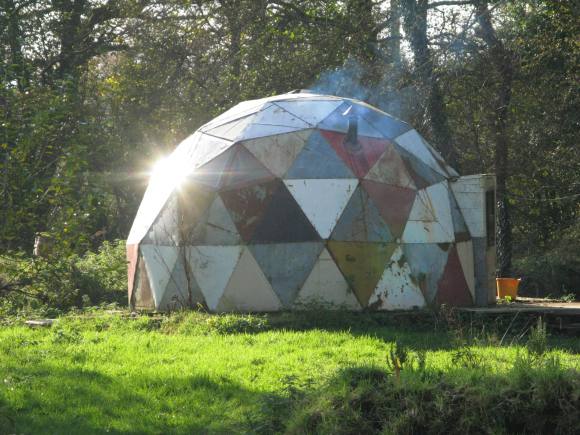
When the artist Alex Hartley built a geodesic dome out of scrap metal for his 2011 exhibition at Victoria Miro, he invoked Drop City, an iconic northern Colorado commune of the mid-1960s. Drop City achieved sudden fame in 1965 through the patronage of Buckminster Fuller. Patronage is perhaps too emphatic – Bucky gave the Droppers $500 because they wrote to him. But by 1967 it had become one of the nodes on an international freak network, spoken in the same breath as the UFO Club in London or Haight-Ashbury. It had its own festival (‘Joy’) in June 1967. Even the normally stuffy architecture journals hit on it, big time. Even if hardly anyone actually went, it was, no question, a place to be. For most, Bucky’s dome was best known as a scheme to seal Manhattan from the elements under a structure of truly Biblical proportions, Man’s final triumph over Nature.

Drop City was by contrast staggeringly crude, bodged from wooden props from a nearby mine, and the rooftops of wrecked cars. Salvaging the latter required an axe, a steady nerve, and enormous physical strength. Fortunately, the early Droppers had all three. The images of the complete camp become icons of the sixties scene, and their continuing power rests in the way they refuse time. The dome form connotes futurity, but these domes, the animals wandering about them, and the sheer bleakness of the landscape connote something from the far distant past. It could be far in the future after some apocalypse; or it could be the remnant of some sophisticated civilisation that remained incorrigibly off the grid.

That ambiguity is exactly the sort of thing that appeals to Alex Hartley – so he set about building a dome with his assistant Will, poring over what few fragments there were to say how one might be built. There were a few problems to work out. Preparing for the damp English climate, they inserted a modern weatherproof layer between the wood and the metal. The car tops were a more serious issue. Detroit 60’s metal yielded at last four panels per car, whereas European vehicles produced barely one; and the cutting technique of the original Droppers was beyond even Hartley. The result is remarkably fine however, rather better (I am certain) than the original. The panels fit beautifully and the interior is exceptionally snug. When they’d finished, Hartley lived in the dome for the duration of the exhibition, tending chickens (at least those that survived the predation of the local foxes) and fishing in the pond. When the show finished, Hartley fitted out the dome for use by Occupy London. It didn’t make it to St Paul’s in time, but it did end up in Finsbury Square where it functioned briefly as intended as a public meeting place – before being appropriated as a kind of party zone for the enactment of drug-and-booze-fuelled fantasies.

Removing the dome at the end of Occupy Finsbury, Hartley described it having reached a condition of unspeakable decay. A beanbag had exploded, producing what he described as ‘vomit lucky dip’, an astonishing amalgam of polystyrene beads, used needles, used condoms, a dildo, vomit and human faeces. In this, Hartley’s dome exactly parallels the story of Drop City. The commune’s early history is that of civilisation – a new form of citizenship with all the attendant rights and responsibilities, and a highly developed sexual morality paralleling that of the middle class world outside. After the ’67 Joy Festival, its leaders lost interest, and it quickly degenerated into a neo-Hobbesian state of nature.

The Dome’s back in Devon now, where it was originally made. It emerges from the mud, glistening gently in the sun. It looks fantastic. What happens now? Hartley himself isn’t sure. For planning purposes it’s a de facto yurt, which enables its continued existence, at least for the time being. But it’s much more than that. An imaginative space of the first order, there’s nowhere better to reflect on dreams of utopia. Put it in Parliament Square, I say.


OSCAR NIEMEYER REMEMBERED

First posted 7 December 2012 on http://citythreepointzero.wordpress.com. See also the Foreign Policy article on the same topic: http://www.foreignpolicy.com/articles/2012/12/11/the_architect_of_the_future_that_never_was
slide06
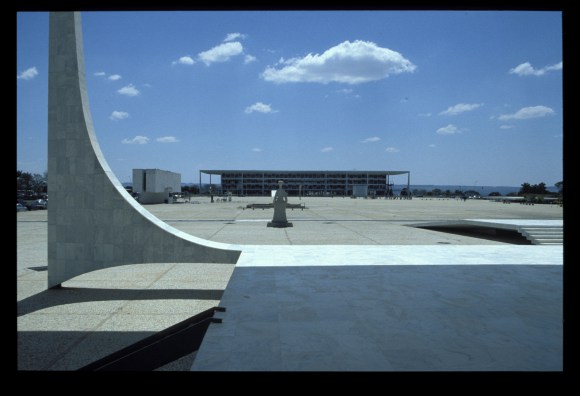
The great Brazilian architect Oscar Niemeyer who died on 5 December, was a character for sure. I met him in 2001 on a visit to Rio and Brasilia that a few years later led to a book and a few articles. A Carioca friend, a composer, put me in touch with Niemeyer and we secured an appointment at his Copacabana office. Driving downtown to the appointment I was paralysed with nerves, not helped by some mischievous advice from my friend’s brother-in-law on how to address the great man. ‘O senhor Niemeyer. Você e um Saco’ (Mr Niemeyer. You are a pain in the arse’). We arrived at a turquoise art deco block on the beachfront, went to the top floor, entered the office, and were shown to a desk adorned with a large black-and-white photograph of two young women lying on their backs, naked. A tiny, prune-like man in a crisp shirt greeted us – Oscar Niemeyer. Chainsmoking cigars throughout the meeting, he really was remarkably obliging. He showed us a funny animated film, in which he arrived in his saucer-shaped MAC building, as if from outer space. We talked about his latest work, jazz, his routine (beer, sketching the girls on the beach), Brasília. Brazil’s futuristic capital, inaugurated in 1960, was to be the centrepiece of my trip. I’d planned a week there. A week, Niemeyer laughed. I was mad. A day or two was enough.
The remark about Brasilia stayed with me though, because it revealed a distinctive, and curiously two-dimensional, attitude to architecture. Niemeyer’s buildings are well-known as photographs and as recently as 2001, photographs were as close as most of us were likely to get to experiencing them. Fortunately, they’re fantastically photogenic. The images of Brasília’s inauguration in April 1960 by Rene Burri and Marcel Gautherot are among the best, and most widely published images of modern architecture. Starkly dramatic, they signify, better than almost anything else, what it meant to be modern.
The reality is often something else. The pictures give no idea of their environmental performance, often hopelessly at odds with their surroundings. The cathedral, all glass in a city with one if the highest indices of sunshine in the world, is a furnace (a literal hell in summer, perhaps a joke – Niemeyer was an atheist). The ministry buildings, aligned perfectly so one face would be blasted by the heat in the morning, the other in the afternoon. Reality intrudes in terms of construction, too. The buildings of the capital are beautifully done, but elsewhere, most are not, Niemeyer’s pure forms invariably undermined by crude finish and poor (or non-existent) maintenance. Brazil’s cities are littered with these modern ruins. The 1996 Museu de Arte Contemporanea in Niteroi, is a case in point. Lauded by the world’s architectural press, it looks superb at a distance. Up close it’s all lumps and bodges, a primary school art class’s approximation of a flying saucer.
Niemeyer himself was well aware of such criticisms, but they meant nothing to him. This was less to do with his unassailable prestige, than an attitude. He genuinely didn’t feel any responsibility towards the buildings once built. He was an artist, first and foremost and as such, his job was to create new forms. You might as well criticise Surrealism for failing to care adequately for lobsters, or design good telephones. That attitude has saddled Brazil with some expensive architectural conservation problems – but it has also proved enormously influential. Libeskind, Gehry, Zaha Hadid and their followers have all carried forward the concept of architecture as icon-making, and that concept, in turn, powerfully informs architectural training the world over. It’s a problematical attitude as regards the future of architecture. But it has produced some spectacular, highly affecting images of modernity. Niemeyer had plenty of shortcomings as an architect, but as an image-maker, he was peerless. Remember him through the pictures of the work, not the work itself.

CORSON: THE RULES

img_4844

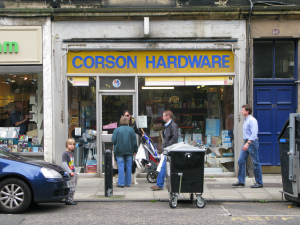
This now legendary piece was first posted 8 September 2012 on http://citythreepointzero.wordpress.com/ It describes a hardware store in Edinburgh from which I have tried to buy many things over the years, entirely without success. Since posting, I came to realise I was not alone: hundreds, perhaps thousands of people had experienced the same thing.  The game took on a life of its own: see the the comments after the original post, well worth reading. After drafting the rules, I took to playing every Saturday with my son, Alex, then aged 7. He would choose the item we would attempt to purchase, and we recorded the result. Rule (7) was deployed surprisingly often, so many games ended pointless. We often – to our amazement – found other people playing the game too. I am not making this up.       

“CORSON”: THE RULES

“CORSON” is a game for two players. Players must take the role of either the CUSTOMER or CORSON. The game is played in an old-fashioned hardware shop in Stockbridge, on the North side of Edinburgh. The play has competing objectives. If the player is the CUSTOMER, the objective is simply to buy any item from the shop. If the player takes the role of CORSON, the objective is to prevent the CUSTOMER from making a purchase. Detailed rules follow:

1. The CUSTOMER enters shop and requests an item of hardware normally found in such a shop. Nails, screws, bolts and tools are all typical requests. Toasters, vacuum cleaners and other domestic goods are also acceptable requests. For a request successfully fulfilled by CORSON, the CUSTOMER scores 1 point.

2. CORSON cannot refuse a request for an item he has in stock at the time of play. He may however immediately refuse any request for an item not described in sufficient detail. For example: a request for ‘a nail’ may be refused on the grounds of insufficient detail. Likewise, ‘a toaster’ if it does not specify colour, design etc.

3. CORSON may also legitimately refuse a request on the grounds that the particular item requested is ‘not for sale’, although this move is permitted only once per round.

4. After a failed request, the CUSTOMER is entitled to ask for one further item. The same rules apply.

5. If after two failed requests the customer has not succeeded, he must leave the shop at once. CORSON should smile enigmatically as the CUSTOMER leaves. CORSON scores 1 point. This outcome is of itself known as a ‘Corson’.

6. The ‘ladder’ rule. CORSON may choose to climb a ladder at any point to search for requested items. If CORSON deploys the ladder and fails to find the requested item, double points (2) are awarded. If as the resort of the use of the ladder, the CUSTOMER is successful, then double points are due to the CUSTOMER.

7. The ‘early closing’ rule. CORSON always closes on Wednesday afternoons and Sundays during which time the game may not be played. At any other time, CORSON is entitled once per game to close the shop in order to prevent a sale. No points are awarded to either party in this case.

8. The ‘Parrafin’ rule. The CUSTOMER is entitled, once per game, to ask for ‘parrafin’, an item which CORSON always has in stock. ‘Parrafin’ counts as a successful sale, but no points are awarded to either player in this case.

9. How long to play. The game is played on a weekly basis, over a decade. At the end of each decade, the CUSTOMER and CORSON add up the points scored. Whoever has the largest number of points wins. At this point, players traditionally switch roles.

10. Disputes, and further information. The long duration of the game makes accurate recording of play essential. A notebook for the purpose can be purchased from many retailers in the vicinity, but, it should be stressed, NOT from CORSON himself. Attempts to buy a notebook from CORSON cannot be counted as play. Disputes over play should be directed to The Adjudicator, Board of Corson, 30 Woodburn Terrace, Edinburgh EH10. The Board meets twice per year, and considers all reasonable requests. The Adjudicator also organises an annual Corson Ladder. Entrance to the Ladder is by invitation only, determined by the Board on 1 March each year.