Two New Posts

Here are a couple of new pieces in print. More in the pipeline from Monocle, and the Times Higher. Details to follow.

Interview about Sex and Buildings. ‘Architects always seem pretty uncomfortable with feelings’, Building Design (9 August 2013) http://www.bdonline.co.uk/culture/architects-always-seem-pretty-uncomfortable-with-feelings/5058889.article Register free for access.

‘Sex in Architecture’, MAP (6 August 2013), online. http://mapmagazine.co.uk/9664/sex-in-architecture/

EXHIBITION REVIEW: RICHARD ROGERS, ROYAL ACADEMY, LONDON

Photo0066

The idea of ‘civility’ crops up a lot at Richard Rogers’s exhibition. It’s there right from the start in a room decked out in orange vinyl, with a series of panels laying out Rogers’s ‘ethos’. In practice, it’s most clearly represented in Rogers’s non-architectural work, such as his chairmanship of the New Labour government’s Urban Task Force (1999), his work as London’s architecture ‘tsar’ for then Mayor, Ken Livingstone, his Reith lectures for the BBC, and his books. Cities for a Small Planet (1997) is the best known of those, and it has been good business for both Rogers and Faber and Faber. All of this work pushes a beguilingly simple message: we should all stop being beastly to each other, beastly to the planet, and learn to live in cities. Until then, we are doomed. Good behaviour and armageddon are entwined: do right, and we live, he seems to suggest; misbehave and we all die. It would be an abominably Victorian message if it wasn’t delivered with such urbanity. But Rogers is charm personified, and he somehow not only gets away with it, but has got the rest of us to believe him.

In practice Rogers thinks that civility can be built. His birthplace, Florence is civil, as is Barcelona and most of Paris, as increasingly, he thinks, is London, or at least those bits which have been remade according to his preferences. More generally, coffee drinking encourages civility – here he sounds positively eighteenth century – and as if to prove it, the last room of the exhibition has a cycle-powered coffee cart from which you can purchase a latte and reflect on city life.

It’s a measure of Rogers’s success that all of this now seems so normal. In 1986, when he exhibited at the RA, his ideas (pedestrianise Trafalgar Sqaure, civilise the Embankment, make spaces for people) were rather exotic. The government of the day wasn’t interested. Twenty five years later, almost all of what he then wanted has been achieved, if rarely by Rogers himself. Moreover, London has grown hugely, adding almost two million residents, with no end in sight to its growth. Not only that, but these residents have come, by and large, to the inner city. The balance of power has shifted to the city from the suburb. Its new residents aspire, for the time being, to a city life.

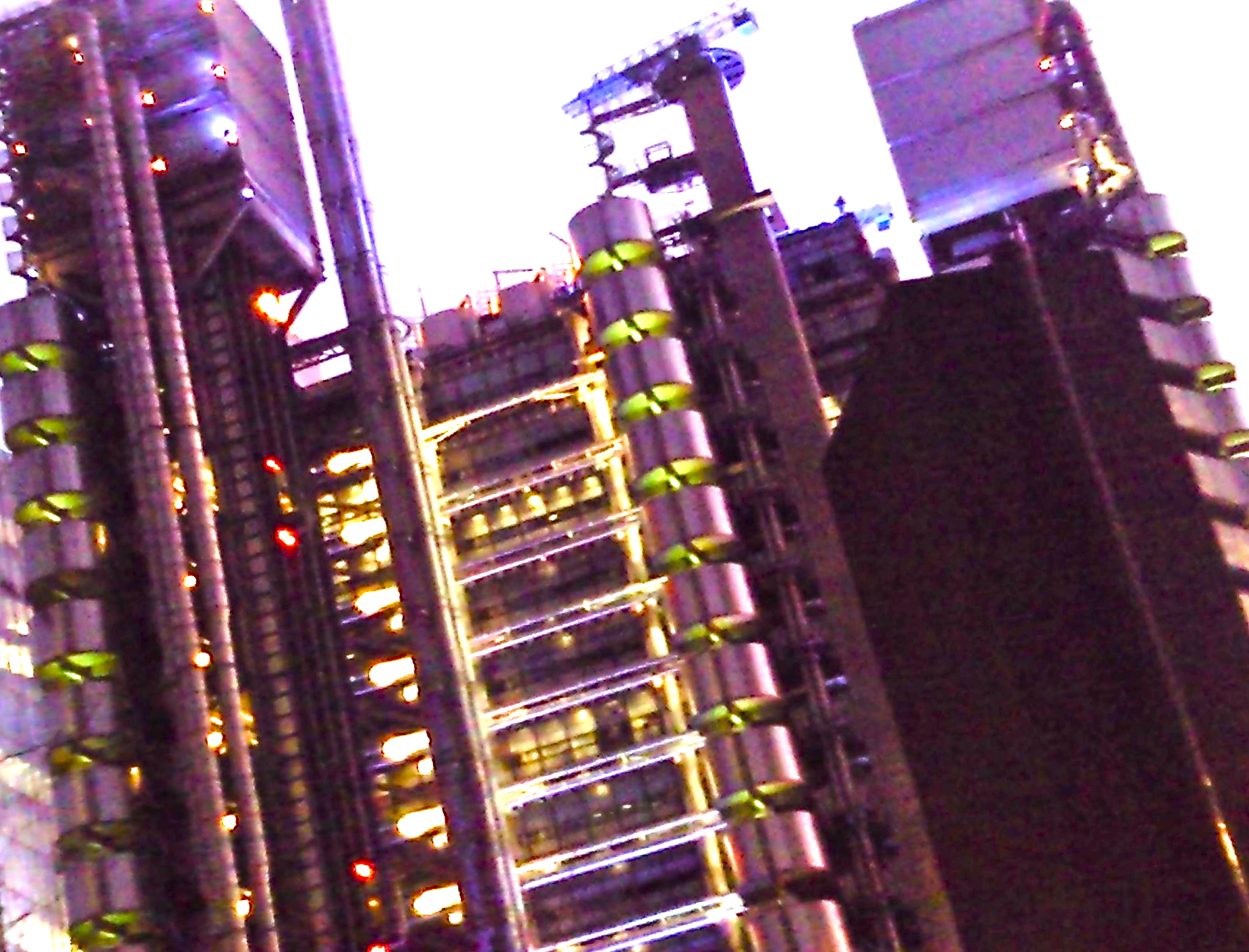
The odd thing is how little Rogers’s built work expresses civility. His best buildings are really profoundly uncivil. The Centre Georges Pompidou (1977) involved the wholesale demolition of a city block, and the insertion of a building alien to anything in Paris – indeed the world – at the time. The Lloyds Building (1985) repeated the same trick in London. Both buildings celebrated the temporary and emphemeral in contexts that more or less demanded the opposite; both showed indifference verging on hostility to their surroundings; both look (like the imaginary works of Archigram that informed them) like they might just rise up on pneumatic stalks and move on, once they’d exhausted their local resources. The aesthetic has been toned down of late. But the latest building, the skyscraper at Leadenhall St in the City, has acquired a suggestive nickname, ‘the Cheesegrater’. It refers to its triangular outward form of the building, of course, but it also describes an abrasive tool made to shred things that get close.

I like this incivil character in Rogers, and there are plenty of examples of it at the RA exhibition. The Pompidou and Lloyds are fantastic buildings precisely because they don’t appear to give a damn about their surroundings, or indeed anything. I like them in exactly the same way I like J. G. Ballard, or early Hawkwind, or Blade Runner: they’re cheerfully amoral, rolling in the ruins of the apocalyptic present. They trash humanism, or so it seems.

The contradiction between Rogers’s buildings, and his rhetoric has never been properly explained. He and his advocates have tried by claiming civility for the early buildings. That’s why the Pompidou is more often these days described as an extension of the (civilised) Place Pompidou, rather than a soixante-huitard’s attack on the bourgeois city.

However, perhaps the contradiction isn’t what it seems, however. Civility tends to be expressed from a place of privilege, and in this, Rogers is no exception. The imagination of civility – of which there is copious evidence at the RA – is a life of leisure: drinking, eating and talking in beautiful city spaces. Nobody does a scrap of work. The now iconic image of Trafalgar Square from ‘London as it Could Be’ (1986 – actually a drawing by Rogers’s long-time associate Mike Davies) imagines this key public space as a de facto sculpture gallery, populated by people who have just spilled out of the National. The art museum and the public space are coterminous. Nothing wrong with that – except that this mode of being in public, the leisured promenade is the only way Rogers and his friends can imagine public life. Civility equals politeness here; it’s manners sublimated to morality. And it really helps if you’ve got plenty of cash. Rogers’s client base is rarely the ‘public’ of which he likes to speak. More often than not it’s the corporate financial sector, or the super rich, the business traveller. The Welsh Assembly in Cardiff is a rare exception.

Leaving the RA and heading north, it was striking how much Mayfair seemed to embody Rogers’s notion of civility. Its urbanity, cosmopolitanism, and sense of ease seemed to embody everything Rogers meant by civility. But it is also the most expensive neighbourhood in the known universe. Very few of us can afford to spend any time there, let alone think of calling it our own. And its civility is supported by a vast labouring army, who – like the coffee-vendor in the gallery – contribute to the spectacle, without being able to enjoy it. For those reasons, civility to me often connotes cruelty, albeit of a hidden kind. At best it’s bullshit, and I think it ultimately diminishes Rogers’s work. Architecture, like all the arts, is fundamentally amoral. If you’re going claim otherwise, you better have a pretty strong claim. This ain’t it.

Richard Rogers RA Inside Out is at the Royal Academy, London, until 18 October 2013. For more on Rogers and civility, see my book The Anxious City (London: Routledge, 2004)

‘The History Man’, Revisited

20130715-190718.jpgMalcolm Bradbury’s novel The History Man was published in 1975 and made into a highly-regarded TV series in 1981 starring Anthony Sher. It concentrates on two days in the life of Howard Kirk, a radical sociologist at the fictional English university of Watermouth. Kirk is in many ways monstrous. A serial philanderer, professional troublemaker, he is the chief protagonist in four seductions and a campus riot, and is strongly implicated in two attempted suicides, the first a close colleague, the second his wife.

I first read the book in ’81, after watching the TV adaptation. Aged 14, a  lot of the subtlety went over my head. I didn’t understand the psychosexual dynamics of Kirk’s relationship with his embittered wife, Barbara, nor the academic satire, having yet to experience the delights of a departmental meeting, the focus of the second half of the book.

I did respond to Kirk, though, especially as imagined by Antony Sher. Wiry, muscular and immaculately-dressed in a 70s-retro way, for me he was far from loathsome, but the epitome of cool (I missed the ironies of the production, of course – Kirk’s toned physique the result of long hours of hard work in the gym, rather than the life of a party animal; his rampant heterosexuality brought to life by an openly gay actor).

My second reading, ten or so years later, revealed these things more clearly. It also made obvious what a shit Kirk really was, and also how, as the cover blurbs suggested, the whole thing might be interpreted as a reactionary dissing of the sixties.

Reading it more recently I realised all that again – but I was also struck by how much the book is about architecture, or how much architecture conditions what people do in it. I really should have cited Bradbury in Sex and Buildings, for everything I was interested in in that book is there. An early sequence has Kirk arranging his rambling Victorian house for the party; every intervention, however slight, is meant to communicate: a door ajar here, a cushion there, a strategically engineered power cut in a corridor, all meant to engineer as much erotic action as possible. Kirk sets the architectural scene, and manages it periodically, a Lord of Misrule filling glasses with wine and making constant adjustments to ensure the maximum possible interaction. The Kirks’ bedroom is a key site in these episodic transitions, shifting from a private space (before the party in its early planning stages) to a place of invited transgression (the early stages of the party), to a place of a full sale orgy. Other rooms gradually acquire erotic characters as the evening wears on: Kirk’s study becomes the site of his seduction of Felicity Phee, a disturbed graduate student.

Bradbury’s interest in architecture extended to public spaces too. His account of the fictional University of Watermouth (it could be Keele, or Essex in real life, with dollops of Bradbuy’s home institution, UEA) plays with the Finnish architect’s attempts to engineer social life. Eating has its own complex erotics, played out in highly complex interiors, designed to facilitate a range of contacts depending of the formality of the space. Or teaching: Kirk’s sociology class takes place in a room whose arrangement must be thoroughly deconstructed in order to facilitate an appropriately liberated discussion.

In Bradbury’s world, the official attempts at social engineering never work. At the University, nobody eats in the right places in the shared canteen. But Kirk’s local engineering always succeeds, so his parties are orgiastic riots. In this fundamentally pessimistic book, that’s usually read as a victory for Kirk’s machiavellianism. Well, in terms of the book’s narrative arc, it is.  But read dispassionately, it shows better than almost anything else I can think of how space and erotics might be connected. I should have remembered.

Review of Adrian Forty, Concrete and Culture (London: Reaktion Books, 2012)

A version of the following review appeared in Sculpture Journal in 2013

forty

Everybody has a view about concrete, but few of these views are exactly the same: there is no material so contradictory and complex in its application and meaning. I myself became fully aware of concrete’s contradictions in Brazil, latterly accompanied by Forty’s edited book on the country’s modernist architecture (Brazil’s Modern Architecture, 2007). I had never seen so much concrete. But equally I have never been confronted with such a disjunction between aspiration and application. Standing outside Oscar Niemeyer’s MAC art museum in Niteroí, it was impossible to square the MAC’s futuristic form (a flying saucer) with the crudeness of its execution (all cracks and, lumps, like a primary school project). That contrast was really quite disturbing, as the official photographs of the MAC depicted a building of otherworldly sleekness whose construction was a mystery to earthly folk. I was alert to concrete’s contradictions from that point on.

Concrete and Culture deals precisely with those contradictions. It expands the thesis Forty set out earlier in Brazil’s Modern Architecture about another iconic building in that country, Vilanova Artigas’s Faculty of Architecture and Urbanism (FAU) at the University of São Paulo (1968). A giant concrete box on stilts, it is both exceptionally sophisticated as engineering, and exceptionally crude in finish (its surface these days is so decayed, you can easily mistake the building for a ruin). Forty argued that this tension was uniquely bound up with concrete itself, and was wholly intentional, a way of making public a set of anxieties about Brazil’s development at the time. It is simultaneously rich and poor, sophisticated and crude, old and new. The argument about FAU is expanded here to make a thoroughly global thesis about concrete’s contradictions. It is one of the key symbols of modernisation, but found naturally, and used by the Romans; it is an industrial material, but also a natural one; it is supposed to lead to efficiencies in the building process, but is dependent on a lot of low-grade physical labour; it connotes modernity in one place, historicity in others; it is simultaneously liquid and solid. And so on.

The book is organised around five key oppositions, represented in suggestively-titled chapters (‘Mud and Modernity’, ‘Natural or Unnatural’, ‘Heaven and Earth’, ‘Memory and Oblivion’). Other chapters explore concrete’s complex geopolitics, its equally complex relationship with industrial labour, and its representation in photography. Even concrete’s fiercest detractors would be hard pressed to deny its photogenic character, especially in monochrome at high ASA ratings. And as Forty argues, there are material similarities between the processes of building in concrete and taking a photograph. Film is a key reference point too:  there is a compelling account of the dry concrete bed of the Los Angeles river as a setting in John Boorman’s Point Blank (1967). Forty is particularly good in showing how a particular material detail might represent ideology. In the case of FAU, it’s the building’s strangely attenuated column give the impression of colossal weight supported by very little, a metaphor for Brazil’s underdevelopment. On the Economist Building in St James’s, London, familiar to British readers he alights on a tiny detail: at the base of the columns holding up the Economist tower, the Portland stone cladding is intentionally stopped a few inches from the ground, a ‘Brechtian trick’ in the words of the architects, making visible the structure. It is a ‘demure lifting of the skirt to reveal a glimpse of ankle’ writes Forty, a joke (he argues) you would never find in American concrete. On BBPR’s highly eccentric Torre Velasca (1958)in Milan, Forty writes of the subversion of the modern tower form. This one, with its rough, and now weather-stained surface and its bulging upper structure recalling the form of Renaissance palazzos, suggests a building as much of the past as of the future, in marked contrast with American skyscraper design. Here again is the contradiction of concrete in relation to history: a supposedly modern material here used to signify if not antiquity, an accommodation of the past. One chapter, on labour, departs from the general focus on the aesthetics of concrete. Here Forty makes clear the sheer amount of physical effort involved in concrete constriction. Again, I had myself reflected on this in relation to Brazil, where I recalled the communist architect Sergio Ferro’s account of the building of Brasília. Ferro detailed not just the long hours, and the brutality of the organisation (both well reported) but the peculiar horror of working with the steel reinforcing rods, their tendency to scrape and gouge limbs.

Forty sets out a range of evidence to argue that the use of concrete allowed the building process to be broken down into a much wider range of unskilled tasks, which in turn meant a greater possible reliance on cheap labour. Concrete explicitly didn’t mean automation, or prefabrication, but the strange sublimation of what were essentially craft skills. He reproduces an extraordinary diagram from 1912 by Frederick Taylor and Sanford Thompson detailed every stage in the manufacture of ‘anything’ in concrete. The table reproduced covers the mixing of cement, listing the time taken to cut the string on a bag of cement (0.11 min), ‘moving the bag about 2ft.’ (0.08 min) to lifting the bag of cement to the shoulder (0.30) and several other actions. The detail is mind-boggling. Reproducing it in the somewhat effete context of architectural history gives it the whiff of conceptual art (routine process repeated to absurdity, then documented). But it also makes clear the contradictions involved in concrete construction: a process commonly thought to save on labour compared with traditional forms of building in fact does nothing of the sort; and a process equally commonly thought to be advanced turns out to be dependent on the most rudimentary skills. Taylor and Thompson’s diagram in essence is the book’s argument: what is supposed to be modern, isn’t – and its irrationality borders on the surreal.

The last chapter of the book, ‘A Concrete Renaissance’, surveys the now-familiar revival in concrete’s fortunes in the world’s rich countries as a material for buildings whose clientele both understand and appreciate its contradictions. Peter Zumthor’s extremely refined work makes use of concrete’s rough character for aesthetic effect. The images here index what’s survived: the LCC architects’ South Bank arts complex, Bo Bardi in Brazil, Alvaro Siza in Portugal, Peter Zumthor in Switzerland. What has survived, and revived in these refined contexts is concrete as aesthetic rather than structure; it’s valued for what it looks like, much less for its structural qualities. Its capacity to stain and degrade has become a value, not a flaw (see also Herzog and de Meuron’s Rudin House, which looks permanently drenched).Forty is right to point to a renaissance of concrete’s fortunes in Europe, where a taste for concrete is now, at least in some circles, an indicator of cultural refinement. Concrete’s contradictions, explored in such depth in the book, are now, in Europe, its defining characteristic. Its flaws are cultivated; to appreciate its difficulties is a sign of taste. Of course this is a minority, essentially avant-garde taste: it can only build cultural centres and privately commissioned houses, no longer mass housing, schools or hospitals (or if it does build these things it must be hidden from view).

What Forty doesn’t discuss, nor to be fair, try to, is the cultural understanding of concrete in those places where it is most physically present. The ‘culture’ of the title is the culture of the rich world; he acknowledges that most concrete building actually exists elsewhere. In rich northern places, to build with concrete is a special sort of poverty chic. But in the global South, concrete carries quite other connotations. In Brazil, a country with a particularly acute concrete habit, concrete connotes everything. In Mendes da Rocha and Bo Bardi, it’s the avant-garde material, that looks outwards and backwards to Europe and European modernism. In Niemeyer’s work, it’s modernism again – but it’s also a way of making a curve that stands up. But it’s also the material of choice for Brazil’s ubiquitous high-rise condos and equally ubiquitous favelas, in both cases simply a way of making buildings strong and cheap. The same is true of Peru, and Pakistan to greater or lesser degrees. The anxieties about concrete that Forty describes so well are largely those of a world that has a choice about whether or not to use it. For the rest of the world, it means what ever it has to.

I Heart My City In The Summer: My Top Twenty.

url

National Geographic Traveler has just posted its top 20 best things to do in cities around the world this summer. Here are mine, in reverse order:

20. Stockholm, Sweden Have a tour of the recent riots, taking in some great ethnic food along the way. Take the blue (T11) metro line to the northern suburb of Husby. Then top it off with a spot of nude sunbathing at Ågesta Beach (bus 742).

19. New York, United States Take a trip back in time on the famous New York subway, unchanged in 40 years. Has the US completely lost it? It’s 1973 down there. Lou Reed’s chewing gum, spat out as he left the Velvet Undrground’s session for Loaded in 1969, still visible at Spring St. station, SoHo.

18. Singapore, Singapore Play hide and seek with your kids in the smog (but do wear masks). Plenty of time left to do it: it’s going to last for weeks. Have a drink on the veranda at the Raffles Hotel afterward.

17. Edinburgh, Scotland Tour the the never-ending tram works on Princes St. Are they building it – or taking it to pieces? Your guess is as good as ours. Later on, take the Scottish DNA test courtesy those latter-day eugenicists at http://www.scotlandsdna.com/. Are you pure enough for Scotland?

16. Madrid, Spain Help remove the shanty town at El Gallinero, Madrid. Let’s clean this place up! Take the train to Collado Villalba, and get a cab from there. Great tapas back in Madrid. Try El Museo del Jamon, nr. Puerta del Sol.

15. Tehran. Iran Try a spot of flag-burning in Azadi Square to celebrate the election of President Hasan Rowhani (but not the Iranian one!). Check out the street food: ‘Mexican Corn Cup’ and boiled beets, available everywhere.

14. Doha, Qatar Visit the new Taliban Embassy. If you can find it. They’ve removed the sign.

13. Moscow, Russia Stand up for traditional family values in an anti-gay demonstration. Plenty of choice, free to participate. Then frozen vodka with Moscow’s jet set at Simachev’s, Stoleshnikov Lane.

12. Shanghai, China Take a refreshing dip in the Huangpu River. Watch out for pigs!

11. Paris, France Ever wanted to try your hand at being an air traffic controller? Now’s your chance. France routinely stops air traffic during the summer to let tourists have go at  guiding planes – but without the risk, because they ground them all. Try Paris Charles de Gaulle. It’s popular, though – be prepared for long queues.

10. Venice, Italy Biennial festival of Garbage. The mysterious Biennale attracts pilgrims from all over the world to worship displays of rubbish, and speak in mystical terms, guided by the enigmatic catalogo, a religious text. The origins of this rubbish-worship are obscure.

9. London, England Re-enact the spectacular looting of summer 2011. Just take a train to Clapham Junction (every five minutes from Waterloo), head for the Debenhams department store, and help yourself to whatever you like. Nobody minds. That buccaneering spirit is London’s gift to the world.

8. Detroit, United States Celebrate the city’s culture-led revival with a visit to the opera house. Free entry.

7. Toronto, Canada It’s party time – and boy, do Torontonians know how to let it all hang out. How about sharing a crack pipe with the city’s Mayor?

6. Limassol, Cyprus Check out the spectacular ruins of Europe’s banks, strangely compelling in the sunshine. Great Russian food.

5. Kabul, Afghanistan Model aircraft fans! You’ll think you’ve died and gone to heaven. Actually…

4. Brasilia, Brazil How about some free-running (parkour) on the government buildings of the Monumental Axis? Very popular this summer. Watch out for teargas, though. Then try some authentic Lebanese kibbeh in the Bar Beruite, Asa Sul. Open late.

3. Athens, Greece Learn the ancient art of the moutza in Syntagman Square. Careful what you do with it once you’ve learned.

2. Istanbul, Turkey Meet the friendly local police at Gezi Park.

1. Sao Paulo, Brazil This summer’s hit. Where to start in the South American metropolis? A quarter-million-strong demo on the Avenida Paulista? Check. Blocking the main highway to Santos? Check. Looting of shops and banks? Check. It’s all to play for in summer 2013’s hottest destination.

Here’s the National Geographic’s selection: http://intelligenttravel.nationalgeographic.com/author/iheartmycity/

Review of ‘Sex and Buildings’ in Architecture Today

Republished from Architecture Today.

‘Sex and Buildings: Modern Architecture and the Sexual Revolution’ Richard J Williams Reaktion Books, 224pp, £25

Sex and the city

Cranks, creeps and control freaks populate a study of architecture’s erotic drivers, finds Philippa Stockley.‘In 2003,’ says Richard J Williams in his new book, Sex and Buildings, ‘Cabinet Magazine, a respectable academic journal, held a competition to find the world’s most phallic structure, the winner being an 1890 water tower in Ypsilanti, Michigan, known locally as the Brick Dick.’ A thrusting phallic tower: there’s a surprise. But the necessary part on tall towers is a mere sliver in a study that makes a very thorough fist of exploring twentieth-century connections between sex and buildings. From psychologists to modernists,communards, hippy free-thinkers, novelists, and film-makers, there’s a big cast, plus queer-space makers, hotel designers, feminists and –of course –architects. Williams disarmingly accounts for his interest (whichmust be the reader’s too) by saying that when he started researching, he was suffering ‘a sex-obsessed mid-life crisis in a part of Edinburgh [Morningside] that felt like a prison.’ The book’s early chapters look at psychologists: professional or self-appointed. A dash through Havelock Ellis, Margaret Mead and Alfred Kinsey, with a nod to Le Corbusier and the Modulor, comes out at ‘Dr’ Philip Lovell (real name Morris Sapperstein; real title ‘Mr’). LA-based Lovell wrote a column on healthy living, and became friends with architects Rudolph Schindler and Richard Neutra. All three had strong ideas about living and sex (Lovell thought masturbation was triggered by constipation). Schindler’s own Kings Road house (1911) is one of the earliest examples of indoors-outdoors modernist living, with sleeping balconies and promiscuity built in to the two-family open-plan design. The Schindler marriage soon broke up. In 1929, Neutra built America’s first steel-framed house, for Lovell celebrated in the film LA Confidential as the home of posh pimp Pierce Patchett. Neutra’s obsessive design process was confessedly psychological to the point of intrusive. In his own house he lived like a spider, aware of everyone’s activity in any part of the building: ‘There was no darkness, no mystery, no place to hide.’ The next loon we meet is Wilhelm Reich, inventor of the ‘Orgone Accumulator’, a person- sized box in which, immured in darkness, one was supposed to have intense sensual experience, rather than a screaming freakout. However, as Williams writes with relish: ‘Reich was brought down as a fraud by the FDA in 1955. He was jailed, his books burned.’ The author notes that his study is one of men; men with controlling ideas about how people should inhabit space and how it should affect them, whether a box, house, office block, hotel or city. He looks at the failure of set-ups designed to facilitate male-oriented fantasies of living that, generally, combined lifestyles set around plentiful free love, with women doing the cooking. As he says: ‘Men build and women inhabit the results.’ Some of those results have been unequivocally sexy and successful, such as Lautner’s Elrod House (1968), immortalised by James Bond in Diamonds are Forever. Others, such as the Farnsworth House, in which the client feltexposed by curtain-less windows, less so. The fact that much sex certainly happens within structures that inspire,facilitate, or even enhance it has led to pioneering buildings such as John Portman’s Regency Hyatt Hotel in Atlanta, with its soaring scopophilial atrium, as well as novels such as Ayn Rand’s The Fountainhead and TV series likeMad Men. One is left to deduce that women’s idea of an ideal sexual space may be more enclosed and private than the flamboyant, open, outdoorsy fuck-pad of a heterosexual male. Nevertheless, that female trope is here too, in a wistful communard’s letter to her husband: ‘All I want is a bit of simple, personal happiness. I long for a quiet cornerwhere we could be together undisturbed.’

Philippa Stockley is a critic, writer and painter. Her novel A Factory of Cunning, a sequel to Choderlos de Laclos’ Les Liasons Dangereuses, is published by Littlebrown. 

The Creative City. It’s War.

0041-1THE USE OF ‘WAR’ TO DESCRIBE CITY LIFE IS A CULTURAL STUDIES CLICHE. In City of Quartz (1990) Mike Davis famously described Los Angeles as ‘militarized’, thinking of the bum-proof benches of downtown, and signs on suburban lawns warning of ‘armed response’ to intrusion. Teresa Caldeira’s account of São Paulo, City of Walls (2001) did something similar for the Brazilian metropolis, describing a city so conditioned by fear of crime that it might as well be at war. I’ve used the metaphor of warfare plenty of times myself, for example in my own accounts of Brazilian cities, which noted the tendency of local journalists to describe them as being in a state of de facto civil war. In that piece, I referred to a much-quoted statistic: during the four-year siege of Sarajevo 1992-6, more people of were killed on the streets of Rio de Janeiro, ostensibly a city at peace. War is a cliche, however, and an increasingly inaccurate one in these terms. LA, New York, São Paulo, Rio (etc. etc.) have become immeasurably safer since everyone started talking about how dangerous they were. And while Baghdad kills 50 or so people per day in a state of genuine warfare, it is frankly unethical to even use the term in relation to what are safe and wealthy places.

Still, that is what I am going to do. In my last post, I mentioned Richard E. Caves’s Creative Industries (2000) in relation to the sociability, or otherwise, of the creative city. The  intense, but intermittent, sociability of the creative city is in fact that of a condition of emergency. As Rebecca Solnit has written lately (A Paradise Built in Hell, 2009) natural disasters destroy communities, but also  produce  marvellous new ones. The more I thought about them, the more Caves’s core principles suggested such a condition of emergency. ‘Nobody Knows’, the ‘Motley Crew’, ‘Time Flies’ (and the rest) invoke an exceptional state of being. The future is unknown and unknowable, threats are permanent, change is ever-present, the project (movie, exhibition, artwork, performance, book, campaign) routinely demands the impossible. Time is  essential; everything must be now. The resources required are immense: it must store materials, skills and ideas in anticipation of a future that may never occur. It is subject to high levels of security and secrecy. Its workers are mobile and rootless, and live in de facto camps, separated and sometimes secured from the city proper. And each project – for which read ‘campaign’ – demands absolute commitment. Desertion is death.

Caves doesn’t describe the creative city in quite these terms, but the implication is there to  be had. And at the time he was writing, there were plenty of other writers invoking a sense of emergency in contemporary life: the sociologist Ulrich Beck’s ‘risk society’ is a perfect example.

On the ground, there are real figures of this metaphorical war. Superficially, many of the most creative cities have also been literal ruins at some stage of their development, caused, often enough by conflict (Berlin, London and Manchester bore until recently the literal scars of war). Artists have always been drawn to the ruined parts of cities for economic reasons, but they have also long cultivated an aesthetic of ruination – and resisted attempts to clean up. The creative city and the ruined city often seem to overlap.

However there’s more to this metaphorical war than ruins. Caves says a lot about LA and the movie industry, and if you know that city, you know how reminiscent its great studio complexes are of military encampments or munitions factories: sprawling, secure complexes, surrounded by high walls, blind to the outside world. And inside, they’re populated by transient gangs working secretly to impossible deadlines, for campaigns that become apparent only when they’re in progress. Making movies is uncannily like going to war. It’s no accident that war has been such a natural movie genre. And it’s arguably no accident that LA’s other main activity, at least until the 1980s, was armaments.

If the creative city is also metaphorically a city at war, is it right? The creative city undoubtedly suits those with the wits and education to take advantage of it, and weather its vicissitudes. I have thought of myself in that category often enough. But how does the creative city suit the weak, the sick, the very young? How does it work for anyone thinking beyond the next pitch?

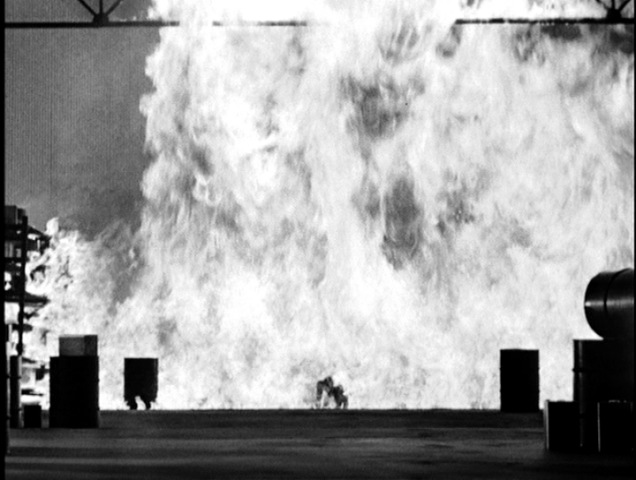
Picture: Still from Alfred Hitchcock, ‘Saboteur’ (1942). Exploding munitions factory created on a Warner Bros studio lot.